


Most businesses do not have a lead generation problem.
They have a visibility problem.
They can see how many leads came through Meta Ads. They can see how much was spent on Google Ads. They can see cost per click, cost per lead and conversion rates inside the ad platforms.
But they often cannot clearly see what happened next.
Did those leads become qualified opportunities?
Did the sales team follow up?
Did they book a meeting?
Did they receive a proposal?
Did they become a customer?
Did the campaign actually create revenue?
That is the gap HubSpot helps close.
HubSpot’s most underrated feature is not just that it stores contacts, manages deals or sends marketing emails. It is that it can connect advertising activity to the rest of the customer journey.
When set up properly, HubSpot can help businesses understand which advertising campaigns are generating real commercial outcomes, not just cheap leads.
Why Ad Platform Reporting Only Tells Part of the Story
Meta Ads and Google Ads are useful reporting tools, but they mostly show what happens inside the advertising environment.
They can tell you:
- How many impressions were delivered
- How many people clicked
- How much each click cost
- How many leads were generated
- What the cost per lead was
- Which ads generated the most conversions
- Which audiences or keywords performed best
That information matters. But it is incomplete.
The ad platform is usually strongest at reporting the beginning of the journey. It is not always the best place to understand what happened after a person became a lead.
That is where many businesses get stuck.
They make decisions based on surface-level metrics like cost per lead, even though cost per lead does not always reflect lead quality or revenue potential.
A campaign with a low cost per lead might look good in Meta, but those leads may never answer the phone.
A campaign with a higher cost per lead might look expensive, but those leads may convert into better customers.
Without CRM-level reporting, it is hard to know the difference.
HubSpot Connects Ads to Contacts, Deals and Revenue

HubSpot’s power comes from connecting marketing and sales data in one place.
When ad accounts, tracking, forms, landing pages and pipelines are set up properly, HubSpot can help show the journey from first interaction through to closed-won revenue.
Instead of only seeing a lead in the ad platform, you can see the full record inside HubSpot.
That can include:
- Which ad campaign influenced the contact
- Which form they submitted
- Which page they converted on
- Which lifecycle stage they reached
- Which sales owner followed up
- Which emails they received
- Which deal they were associated with
- Which pipeline stage they moved through
- Whether the deal closed
- How much revenue was generated
This is the difference between advertising reporting and business reporting.
HubSpot does not just help answer, “Did the campaign generate leads?”
It helps answer, “Did the campaign generate pipeline and revenue?”
Why This Feature Is So Underrated
HubSpot is often sold and understood as a CRM, email marketing platform, automation tool or sales pipeline system.
All of that is true.
But for growth-focused businesses, the real value is in how those pieces connect.
Advertising ROI tracking is underrated because it sits between departments.
Marketing cares about campaigns. Sales cares about leads and deals. Leadership cares about revenue. HubSpot can bring all three views together.
That means the business can stop looking at performance in silos.
Instead of having:
- Meta reporting in Meta
- Google Ads reporting in Google
- Website data in GA4
- Leads in a spreadsheet
- Sales notes in inboxes
- Revenue in accounting software
- Pipeline updates in someone’s head
HubSpot can become the central view of what actually happened.
That is where the platform becomes far more valuable than a simple CRM.
From Cost Per Lead to Cost Per Customer
One of the biggest mindset shifts HubSpot creates is moving beyond cost per lead.
Cost per lead is useful, but it is not the final metric.
For businesses with a sales process, more important questions include:
- What is our cost per qualified lead?
- What is our cost per appointment?
- What is our cost per proposal?
- What is our cost per customer?
- Which campaigns create the highest close rate?
- Which lead sources create the highest-value deals?
- Which ads generate the strongest pipeline?
- Which campaigns look good on lead volume but poor on revenue?
- Which campaigns look expensive upfront but profitable by the end?
This is where HubSpot becomes powerful.
By connecting ads to deals and revenue, it helps businesses optimise based on outcomes that actually matter.
For property, that might mean tracking which campaigns created new managements, buyer consultations or project registrations.
For health, that might mean tracking which campaigns generated bookings, consultations or service-specific enquiries.
For B2B, that might mean tracking which campaigns created discovery calls, proposals and closed-won deals.
The point is the same: the lead is not the end of the story.
HubSpot Helps Identify Lead Quality
A common issue in paid advertising is that platforms are optimised to generate the conversion event you give them.
If the goal is form submissions, the platform will try to find more people likely to submit forms.
That does not always mean those people are likely to become customers.
HubSpot gives you a clearer way to evaluate lead quality after the conversion.
You can review:
- Lead source
- Campaign source
- Form submitted
- Contact activity
- Sales notes
- Deal stage movement
- Qualification status
- Appointment status
- Closed-won and closed-lost rates
- Lost reasons
- Revenue generated
This helps the business understand which campaigns are attracting genuine opportunities.
For example, one campaign might generate 100 leads at a low cost, but only five qualified opportunities.
Another campaign might generate 40 leads at a higher cost, but 20 qualified opportunities.
The second campaign may be far more valuable, even if it looks worse inside the ad platform.
HubSpot helps reveal that difference.
Attribution Reporting Shows the Bigger Picture
HubSpot’s attribution reporting helps businesses understand how different marketing interactions contribute to contact creation, deal creation and revenue.
HubSpot describes attribution reports as a way to measure which interactions lead to contacts and deals being created, as well as revenue being generated. These reports can help show the top, middle and bottom of the funnel through contact create, deal create and revenue attribution views.
That matters because not every campaign creates an immediate sale.
Some campaigns introduce the business. Some bring people back. Some assist the decision. Some convert the lead. Some help push the opportunity over the line.
A good attribution setup helps you understand the role each channel plays.
For example:
- Meta Ads may create first-touch awareness
- Google Ads may capture high-intent search
- Email nurture may support consideration
- Retargeting may bring the lead back
- A sales call may convert the opportunity
- A case study may influence the final decision
Without attribution reporting, it is easy to overvalue the final click and undervalue the rest of the journey.
HubSpot gives businesses a better way to understand how these touchpoints work together.
Campaign ROI Reporting Makes Marketing More Commercial
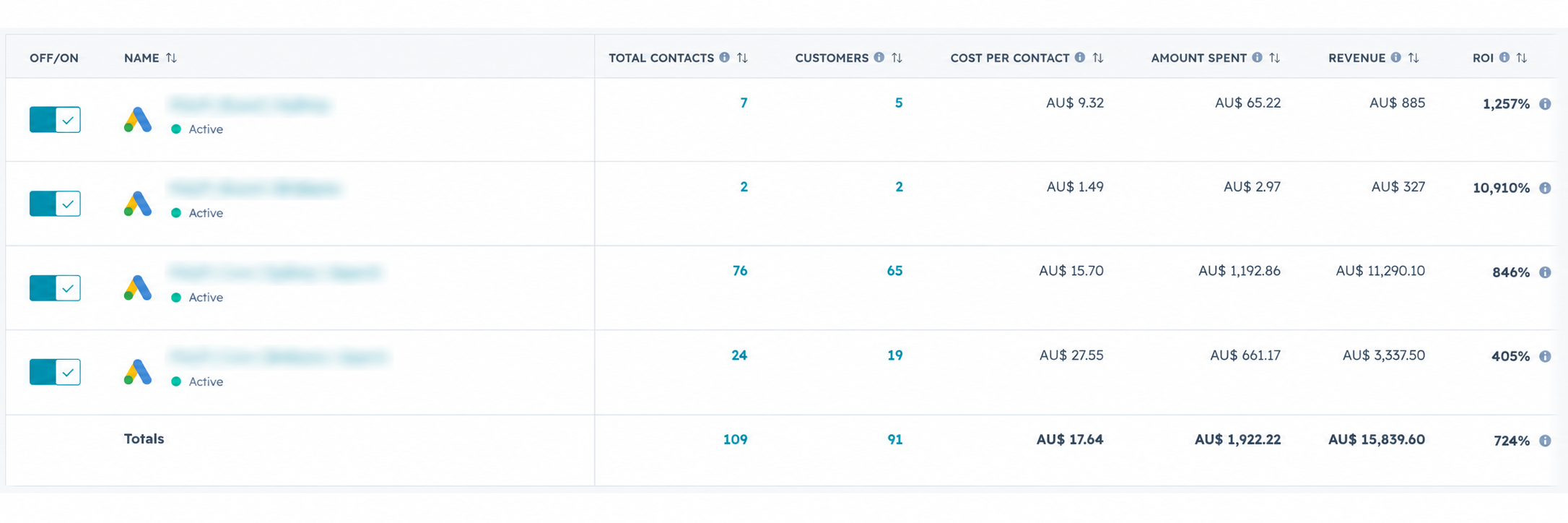
HubSpot’s campaign ROI reporting can calculate ROI using attributed revenue from closed-won deals, or associated deal value depending on the setup and selected approach.
This is a major shift for marketing teams.
Instead of reporting only on activity, they can report on commercial contribution.
That means a campaign report can move beyond:
- Impressions
- Clicks
- Leads
- Cost per lead
- Email opens
- Landing page views
And start including:
- Deals created
- Pipeline generated
- Closed-won revenue
- Attributed revenue
- Cost per opportunity
- Cost per customer
- Return on ad spend
- Lead-to-deal conversion rate
- Deal-to-customer conversion rate
This changes the internal conversation around marketing.
Marketing is no longer just a cost centre generating leads. It becomes a measurable growth engine tied to sales performance.
The Ads Tool Adds Another Layer of Visibility
HubSpot’s ads tool allows businesses to analyse connected ad campaigns, drill into campaign performance and add ad reports to dashboards. HubSpot also allows filtering ad campaign data by attribution reports to understand how ads influence contacts across stages of the customer journey.
This is where the platform becomes especially useful for businesses running Meta Ads, Google Ads, LinkedIn Ads or other paid channels.
When the ads tool is connected properly, HubSpot can help centralise ad performance alongside CRM data.
That means the team can look at advertising performance in the same environment as:
- Contacts
- Companies
- Deals
- Sales tasks
- Email activity
- Forms
- Landing pages
- Campaigns
- Revenue reporting
This is what makes the feature underrated.
The value is not just that HubSpot can display ad data.
The value is that it can place that ad data in the same system as the sales outcome.
Why This Matters for Property Businesses
For property businesses, advertising ROI is often misunderstood.
A campaign might generate enquiries, but the business still needs to know whether those enquiries became genuine opportunities.
HubSpot can help property businesses track:
- Rental appraisal enquiries
- Property management leads
- Buyers agent consultations
- Off-market guide downloads
- Development project registrations
- Commercial property enquiries
- Open home or inspection-related enquiries
- Investor lead magnets
- Referral partner enquiries
More importantly, it can help show what happened after the lead came in.
For example:
- Did the landlord book an appraisal?
- Did the investor speak with the team?
- Did the buyer move into a consultation?
- Did the property management enquiry become a new management?
- Did the project registration become a serious buyer?
- Did the commercial enquiry become a deal?
This helps property businesses understand which campaigns are creating commercial momentum, not just enquiry volume.
Why This Matters for Health Businesses
For health brands, ROI tracking can be more complex because of privacy, platform policies and compliance considerations.
Not every health campaign can or should be tracked in the same way as other industries.
But HubSpot can still play a valuable role in helping health brands understand the journey from enquiry to booking or consultation, where appropriate.
This might include:
- Telehealth enquiries
- Dental bookings
- New patient enquiries
- Treatment information requests
- Body scan or testing enquiries
- Allied health consultation requests
- Service-specific form submissions
- Patient education downloads
- Re-engagement campaigns
The goal is not to misuse sensitive information or create invasive tracking.
The goal is to build a responsible first-party data system that helps the business understand which marketing activity is creating genuine demand and useful outcomes.
For health brands, this can make reporting more accurate while keeping the focus on trust, consent and careful communication.
What Needs to Be Set Up Properly
HubSpot advertising ROI tracking is powerful, but it is not magic.
It depends on the quality of the setup.
To get useful reporting, businesses need to make sure the foundations are right.
That includes:
- Connected ad accounts
- Correct tracking code installation
- Clean UTM naming conventions
- Proper form setup
- Clear lead source properties
- Accurate lifecycle stages
- Deal pipelines that match the sales process
- Contacts associated with deals
- Deal values entered consistently
- Closed-won and closed-lost stages used properly
- Sales activity logged
- Campaigns structured clearly
- Attribution reporting configured correctly
If these foundations are messy, the reporting will be messy too.
HubSpot can only report accurately on what the business captures properly.
The Biggest Mistake Businesses Make
The biggest mistake is treating HubSpot as a passive database.
They connect a few forms, send some emails and use it to store contacts, but they never build the reporting structure properly.
That means they miss the most valuable part of the platform.
HubSpot should not just answer:
“How many leads do we have?”
It should help answer:
- Where did our best leads come from?
- Which campaigns created revenue?
- Which channels are worth scaling?
- Which sales stages are leaking opportunities?
- Which lead sources are wasting time?
- Which offers generate the strongest pipeline?
- Which campaigns look good in-platform but poor in the CRM?
- Which campaigns deserve more budget?
This is where HubSpot becomes commercially useful.
Why It Is More Than an Attribution Tool
Attribution is important, but HubSpot’s value goes beyond assigning credit.
The real value is that it helps create a feedback loop between marketing and sales.
That feedback loop looks like this:
- Ads generate traffic and leads
- Forms capture the enquiry
- HubSpot stores the contact and source data
- Sales follows up and updates the deal
- The pipeline shows the commercial outcome
- Reports show which campaigns drove quality
- Marketing optimises based on real business data
- Sales gets better-qualified opportunities
- Leadership sees clearer ROI
That loop is what most businesses are missing.
They have advertising activity. They have sales activity. But they do not have a connected system that shows how one impacts the other.
HubSpot can become that system.
Final Thought
HubSpot’s most underrated feature is not just its CRM, email marketing or automation.
It is its ability to connect marketing activity to commercial outcomes.
For businesses investing in advertising, that matters.
Because the goal is not just to generate more clicks, more forms or more leads.
The goal is to understand which campaigns are creating real opportunities, real customers and real revenue.
When HubSpot is set up properly, it gives businesses the visibility they need to make smarter decisions.
It helps move the conversation from:
“How much did we spend?”
To:
“What did that spend actually create?”
And that is where advertising becomes far more accountable, more scalable and more valuable.
.png)

.png)

