

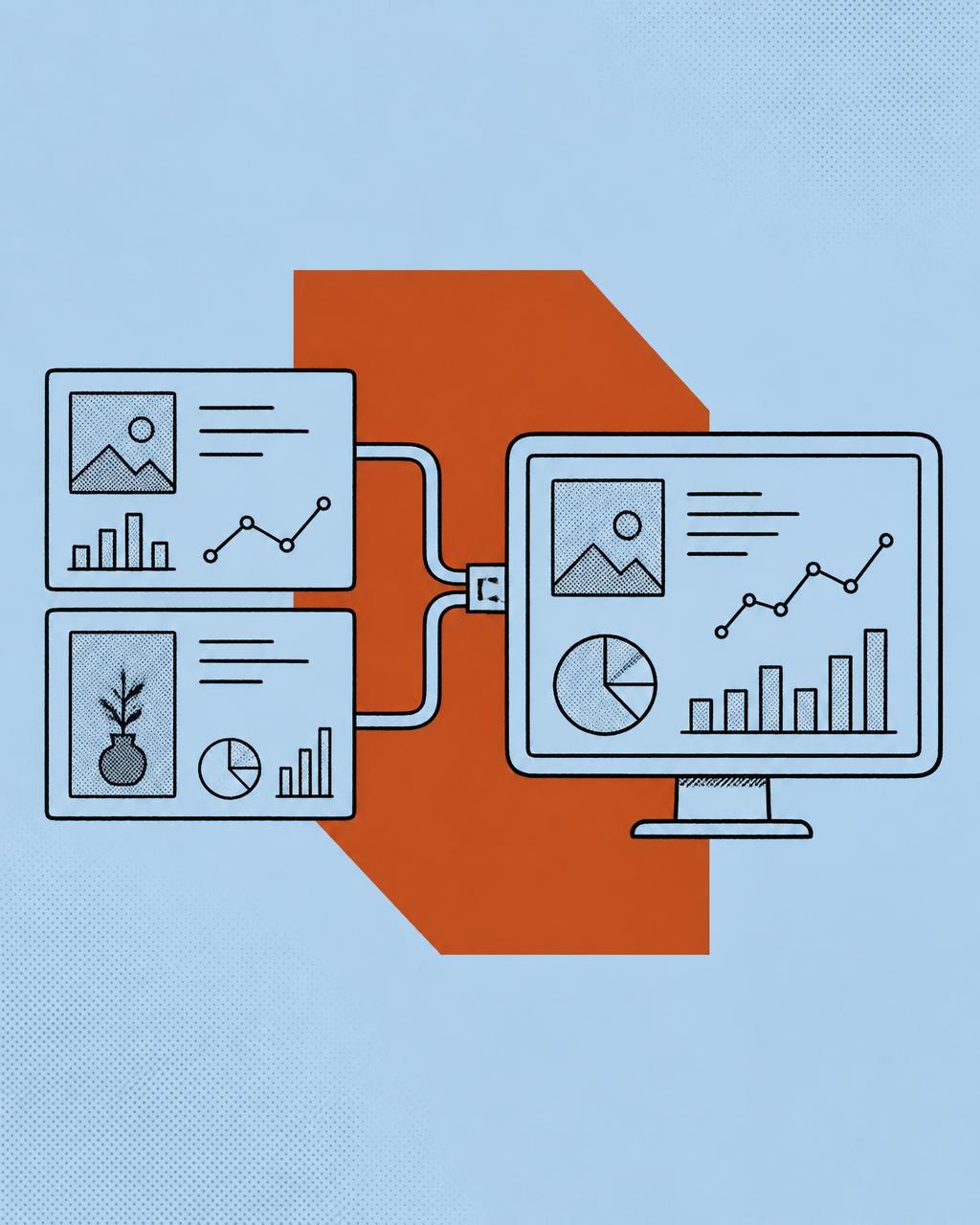

Almost every advertiser we meet is running two disconnected businesses. One lives inside Google Ads and Meta Ads Manager, where success is measured in leads, cost per lead and a return-on-ad-spend figure the platform calculates itself. The other lives inside the CRM, where success is measured in qualified pipeline, closed-won revenue and margin. The two rarely agree, and when the board asks which campaigns actually made money, nobody can answer with a straight face.
HubSpot closes that gap. Not because it is a better ad platform — it does not serve a single impression — but because it is the only place where the ad click, the form submission, the sales conversation and the invoice can sit on the same record. Once those things are joined, digital advertising stops being a media exercise and becomes a revenue system. This is what we mean when we talk about a RevEngine: media, data and sales execution running on one loop.
1. It changes what you optimise towards
Google's Smart Bidding and Meta's Advantage+ delivery are extraordinary at finding more of whatever you tell them to find. The problem is what most accounts tell them to find: a form submission. Machine learning is ruthlessly literal. Ask for cheap form fills and you will get cheap form fills — students, competitors, tyre-kickers, people who meant to click something else, and, in some markets, outright junk.
When HubSpot is connected, you can define the conversion event as something further down the funnel: a contact that reached Sales Qualified Lead, a deal created, or a deal closed at a particular value. That single change reshapes the audience the algorithm chases. In the accounts we manage, moving from form-fill optimisation to qualified-lead optimisation typically raises cost per lead and lowers cost per customer at the same time. The vanity metric gets worse; the business gets better.
2. Every ad interaction lands on the contact record
Connect Google Ads, Meta and LinkedIn to HubSpot and the platform starts stamping ad interactions directly onto contacts. You can see that the person your sales team is calling first arrived from a Performance Max campaign, came back three weeks later through a branded search, downloaded a comparison guide, and only then requested a quote.
That record is useful in three separate ways. It gives sales context before they pick up the phone. It gives marketing a defensible story about which campaigns are seeding pipeline that later closes through other channels. And it gives operations a clean audit trail when a lead quality dispute starts — which it always does.
3. Offline conversion sync feeds real outcomes back to the platforms
This is the mechanism that does the heaviest lifting. HubSpot's ads tools can send conversion events back to Google and Meta when a contact reaches a lifecycle stage or a deal moves to a chosen stage. The platforms match those events back to the original click using the click identifier stored on the contact.
The practical effect is that a lead your sales team disqualified on Tuesday never becomes training data, while a lead that turned into a $40,000 deal becomes a strong positive signal with a value attached. Over a few weeks of volume, bidding shifts towards the keywords, placements, creatives and audiences that produce the second kind of person.
- Sync lifecycle stage changes (MQL, SQL) for high-volume, shorter-cycle businesses.
- Sync deal stage changes with deal amount for considered, higher-value purchases.
- Send negative or low-value signals as well — suppression is as valuable as amplification.
- Give the platforms enough volume: aim for at least 30–50 qualified events per campaign per month before you optimise to them.
4. Audiences that a pixel cannot build
Pixel-based audiences only know what happened on your website. HubSpot knows what happened in your business. That means you can build and sync audiences off any property in the CRM: customers to exclude from acquisition campaigns, churned customers to win back, deals stuck in negotiation for a targeted proof campaign, or a lookalike seed built from your best hundred customers rather than everyone who ever landed on your pricing page.
Exclusion is the underrated half of this. Australian service businesses routinely spend 10–20% of their budget re-acquiring people who are already customers. A single synced exclusion list recovers that spend on day one and typically pays for the HubSpot subscription before anything else does.
5. Attribution reporting that survives a board meeting
HubSpot's multi-touch revenue attribution reports let you distribute credit for closed revenue across every interaction on the path — first touch, last touch, linear, U-shaped, W-shaped or time decay. Because the credit is distributed across actual closed deals rather than platform-reported conversions, you avoid the familiar situation where Google claims 40 conversions, Meta claims 35, and the business booked 12 customers.
The moment you report on revenue instead of conversions, the arguments about channel credit stop and the conversation moves to where it should be: what to fund next quarter.
6. Speed to lead, automated
The best-performing ad account in the world cannot fix a two-day response time. Research on inbound lead handling has consistently found that contact rates fall off a cliff after the first few minutes. HubSpot workflows let you route the lead to the right owner by service line, territory or deal size, fire an SMS or email within seconds, create the task, and escalate if nobody has touched it inside your service level.
This is where paid media budgets are most often wasted, and it is also the cheapest thing to fix. We have seen conversion-to-opportunity rates improve by more than a third from routing and response-time changes alone, with no change to the ad account at all.
7. Creative and landing pages that inherit the data
Because HubSpot hosts landing pages, forms and CTAs, the campaign layer inherits everything the CRM knows. Progressive form fields ask a returning visitor a new qualifying question instead of the same three fields. Smart content shows a different proof point to a returning prospect than to a first-time visitor. The data collected in those extra fields then flows straight back into lead scoring and, through offline conversion sync, into the bidding models.
What to build first
You do not need a twelve-month implementation to get the compounding effect. In our own engagements the sequence that produces value fastest looks like this:
- 01Connect Google Ads and Meta to HubSpot and confirm click identifiers are landing on contacts.
- 02Agree a single definition of a qualified lead with the sales team and enforce it with required fields.
- 03Turn on offline conversion sync for that qualified stage before touching any campaign settings.
- 04Build customer and unqualified exclusion audiences and apply them across every acquisition campaign.
- 05Automate lead routing and a sub-five-minute first response.
- 06Only then move campaigns from lead-based bidding to qualified-value bidding, and hold the change for at least one full learning period.
The honest limitations
HubSpot will not rescue a weak offer, a slow website or creative nobody wants to watch. It cannot recover attribution for a click that arrived with tracking parameters stripped, and consent settings will always leave a portion of the journey unobserved. Long sales cycles also slow the feedback loop — if your average deal takes nine months, a deal-stage conversion signal is too slow to steer bidding, and you should optimise to a reliable mid-funnel proxy instead.
None of that changes the underlying point. Ad platforms will always optimise towards the outcome you define for them. HubSpot is how you make that outcome revenue.
Related services

Written by
Danielle Magbanua
HubSpot Specialist
Danielle architects CRM and automation inside HubSpot — lifecycle stages, pipelines, lead routing and reporting that sales teams actually trust and use.